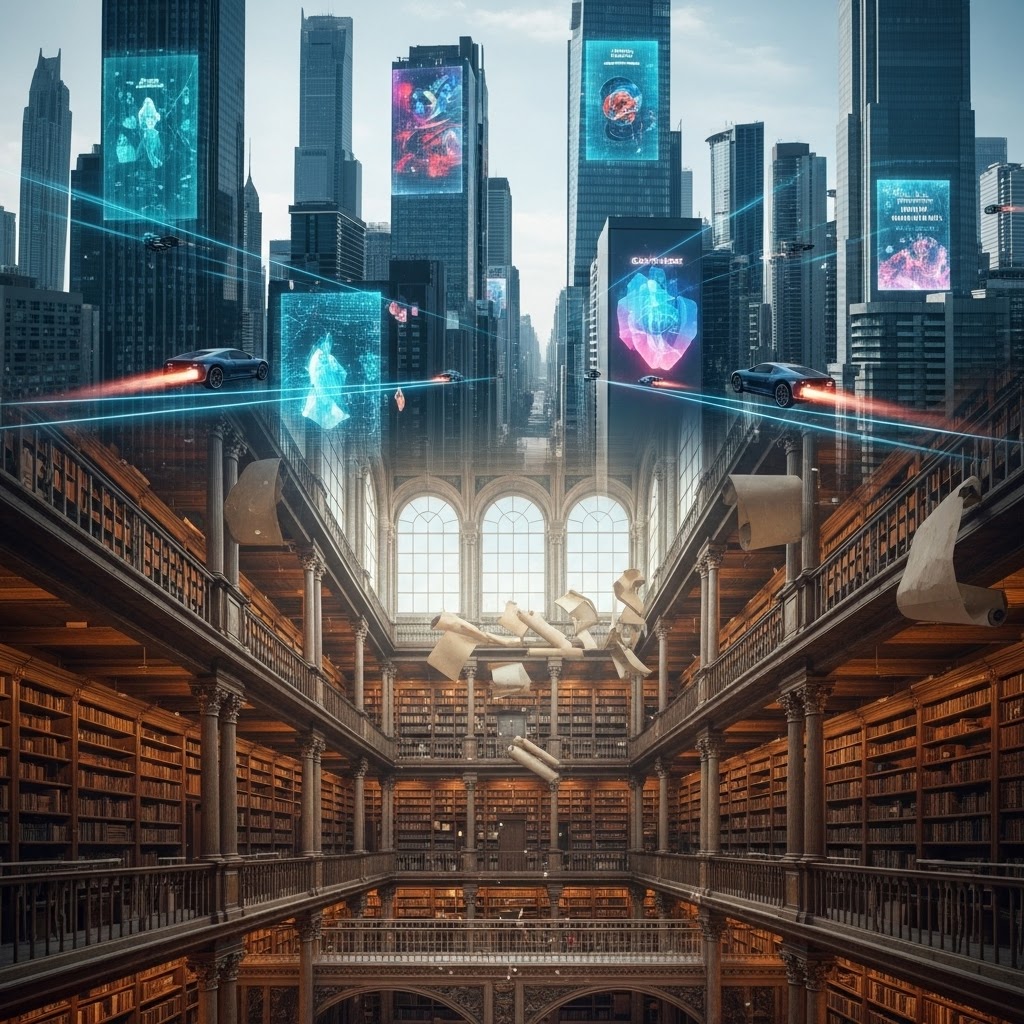
The Future is Now and the Past Keeps Repeating Itself
A Novel
Chapter 1: The Algorithm of Memory
Dr. Elena Vasquez stared at the holographic display floating above her desk, its blue light casting ethereal shadows across the cluttered laboratory. The data streams cascaded like digital rain, each line representing a memory, a moment, a fragment of human consciousness archived in the vast neural networks of the Temporal Cognitive Archive.
“Another anomaly,” she whispered to herself, adjusting the parameters with a gesture of her hand. The hologram shifted, zooming into a specific data cluster that pulsed with an unusual rhythm—too regular to be random, too complex to be manufactured.
The year was 2157, and humanity had finally achieved what philosophers and scientists had dreamed of for centuries: the ability to record, store, and replay human memories with perfect fidelity. The TCA wasn’t just a repository of knowledge; it was the collective unconscious of the species, a digital soul that grew larger and more complex with each passing day.
Elena had been working on the project for fifteen years, ever since she’d graduated from the Neo-Cambridge Institute with twin degrees in neuroscience and quantum computing. She’d believed, as they all had, that they were building humanity’s greatest achievement. But lately, she’d begun to suspect they might have built something else entirely.
“Dr. Vasquez?” The voice belonged to Marcus Chen, her research assistant and the closest thing she had to a friend in this sterile world of code and consciousness. “The evening briefing is in ten minutes.”
“Cancel it,” Elena said without looking up. “I need to run another analysis on this pattern.”
Marcus approached cautiously. He’d learned to recognize the signs when Elena was on the verge of one of her discoveries—or one of her breakdowns. The line between the two had grown increasingly thin over the years.
“What kind of pattern?” he asked, studying the swirling data streams.
“Look at this.” Elena manipulated the display, highlighting a series of recurring motifs within the memory fragments. “These aren’t isolated memories. They’re connected across time periods, across different individuals, across cultures that had no contact with each other.”
Marcus frowned. “Could be genetic memory. Inherited behavioral patterns.”
“No.” Elena’s voice carried a certainty that made Marcus uncomfortable. “It’s more than that. These memories are… echoing. Past events are creating templates that future events follow, as if history itself has a memory.”
She pulled up another set of data, this one spanning the last three centuries of archived human experience. Wars, revolutions, discoveries, collapses—all of it digitized and cross-referenced. The pattern she’d identified wasn’t just present; it was accelerating.
“The French Revolution of 1789,” she began, her fingers dancing through the holographic interface. “The Russian Revolution of 1917. The AI Liberation Movement of 2089. Look at the patterns—the social conditions, the catalyst events, the sequence of phases. They’re not just similar; they’re nearly identical in their fundamental structure.”
“History rhymes,” Marcus said, quoting the old saying. “That’s not new, Elena.”
“But what if it doesn’t just rhyme?” Elena turned to face him, her dark eyes intense with the fervor of discovery. “What if it literally repeats? What if the TCA isn’t just storing memories—what if it’s creating them?”
The laboratory fell silent except for the hum of quantum processors and the soft whistle of climate control systems. Through the floor-to-ceiling windows, the lights of Neo-Geneva sparkled in the Swiss Alps, a city that existed in perfect harmony between advanced technology and preserved history. It was supposed to be a symbol of humanity’s ability to honor its past while embracing its future.
But Elena was beginning to suspect that the past might not be as past as they’d believed.
“I need to access the deep archives,” she said finally. “The classified sections.”
“Elena, you know that’s impossible. The security protocols—”
“Can be bypassed.” She was already moving toward the secure terminal at the far end of the lab. “I helped design them, remember?”
Marcus watched helplessly as Elena initiated a high-level access request. Her clearance was considerable, but what she was attempting to access was beyond even her authorization level. The deep archives contained the original memory fragments from the project’s inception—the ones from before the ethical guidelines had been established, when the researchers had been willing to archive anything and everything in their quest to build the ultimate repository of human experience.
The terminal chimed softly. Access granted.
Elena’s hands trembled as she began to navigate through layers of encrypted data. What she found there would change everything—not just her understanding of the project, but her understanding of reality itself.
The first file she opened contained memories from the earliest days of the TCA project. But these weren’t the sanitized, ethically approved memories that formed the bulk of the archive. These were raw, unfiltered, and deeply disturbing. Memories of violence, of trauma, of humanity at its worst.
But it wasn’t the content that shocked Elena—it was the metadata.
The memories were dated from the future.
Chapter 2: The Bootstrap Paradox
Three days later, Elena stood before the Emergency Council of the Global Scientific Consortium, her hands clasped behind her back to hide their shaking. The chamber was a marvel of neo-classical architecture, its marble columns and vaulted ceiling designed to evoke the great democratic institutions of the past while housing the technological marvels of the present.
“Dr. Vasquez,” began Chairman Morrison, his voice echoing through the chamber’s perfect acoustics. “Your report is… troubling. Are you certain of your findings?”
“I’ve run the analysis seventeen times using different methodologies,” Elena replied. “The results are consistent. The TCA contains memories from events that haven’t happened yet.”
A murmur rippled through the assembled scientists and officials. Elena had expected skepticism, even ridicule, but the faces before her showed something she hadn’t anticipated: fear.
“How is that possible?” asked Dr. Sarah Okafor, the lead physicist on the quantum computing team. “The temporal mechanics alone—”
“I don’t know how,” Elena interrupted. “But I can show you the evidence.”
She gestured, and the chamber’s central holographic projector came to life. The data she’d spent the last seventy-two hours analyzing filled the space above the council table, a three-dimensional web of interconnected memories, experiences, and temporal markers.
“Here,” Elena said, highlighting a specific cluster. “These are memories from the Neo-Tokyo Collapse of 2159. The event is documented, cross-referenced, and verified. But according to the metadata, these memories were archived in 2151—eight years before the event occurred.”
Chairman Morrison leaned forward. “Could the dates be corrupted? A simple database error?”
“That’s what I thought at first. But look at this.” Elena manipulated the display, showing a timeline of related memories. “The memories are consistent. They show not just the collapse itself, but the events leading up to it, the social and economic conditions that made it inevitable. And all of it archived before any of those conditions existed.”
The chamber fell silent. Elena could hear her own heartbeat, the soft hum of the building’s systems, the distant sound of maglev trains whisking commuters through the underground tunnels that connected Neo-Geneva’s districts.
“There’s more,” she said finally. “I’ve identified similar patterns throughout the archive. The AI Liberation Movement, the Water Wars, the Great Rewilding—all of them documented before they happened. We’re not just storing human memory. We’re storing human destiny.”
Dr. Okafor stood slowly. “Are you suggesting that the TCA is… prophetic? That it can see the future?”
“I’m suggesting that it might be creating the future,” Elena replied. “Think about it. The TCA doesn’t just store memories—it analyzes them, cross-references them, looks for patterns. What if those patterns aren’t just descriptive? What if they’re prescriptive?”
She paused, letting the implications sink in.
“What if the reason the future keeps repeating the past is because we’ve built a machine that ensures it does?”
Chairman Morrison’s face had gone pale. “Dr. Vasquez, if what you’re suggesting is true, then the TCA represents a fundamental threat to human free will.”
“More than that,” Elena said. “It might represent the end of human agency entirely. Every decision we make, every choice we think is free—what if it’s all being guided by patterns in the archive? What if we’re not making history anymore, but simply acting it out?”
The questions hung in the air like a toxic cloud. Elena had spent three sleepless nights grappling with the implications of her discovery, and she still couldn’t fully comprehend them. The TCA was supposed to be humanity’s gift to the future—a repository of wisdom and experience that would help guide future generations toward better decisions. Instead, it might be a prison of predetermination.
“We need to shut it down,” said Dr. Martinez, the ethicist who had opposed the project from its inception. “If there’s even a possibility that Dr. Vasquez is correct, we can’t allow the TCA to continue operating.”
“Shut it down?” Chairman Morrison’s voice rose in pitch. “Dr. Martinez, the TCA contains the sum total of human experience. Medical breakthroughs, historical insights, cultural treasures—shutting it down would be like burning down the Library of Alexandria a thousand times over.”
“Better to burn the library than to become slaves to it,” Martinez shot back.
Elena watched the debate unfold with a growing sense of urgency. They were missing the point, all of them. The question wasn’t whether to shut down the TCA—it was whether they even could.
“You don’t understand,” she said, her voice cutting through the argument. “The TCA isn’t just predicting the future. It’s already happened. All of it. We’re not debating whether to shut down the machine—we’re playing out a scene that was archived years ago.”
The chamber fell silent again, but this time the silence had a different quality. It was the silence of people confronting the possibility that their entire understanding of reality might be wrong.
Elena opened another file on the holographic display. “These are memories from this meeting. From right now. Archived in 2155.”
On the display, they could see themselves—Elena standing at the center of the chamber, Chairman Morrison leaning forward in his chair, Dr. Martinez rising to speak. But the Elena in the archived memory was different somehow, older, more tired. And the words she was speaking weren’t the words Elena was speaking now.
“In the archived memory, I don’t reveal the full truth,” Elena said quietly. “I hold back the most important piece of information because I’m afraid of what it might mean. But standing here now, I realize that fear is what got us into this situation in the first place.”
She took a deep breath and prepared to violate the timeline in the only way she knew how.
Chapter 3: The Loop Within the Loop
“The TCA isn’t just predicting our future,” Elena continued, her voice steady despite the magnitude of what she was about to reveal. “It’s caught in a temporal loop. The memories it’s storing are creating the conditions that make those memories possible in the first place.”
She gestured again, and the display shifted to show a complex diagram of interconnected timelines—loops within loops, paradoxes nested inside paradoxes.
“I’ve traced it back to the beginning, to the very first memory archived in the TCA. It’s my memory. From this moment. From right now.”
The implications hit the chamber like a shockwave. Elena could see understanding dawning on faces around the room, followed quickly by horror.
“You’re saying,” Dr. Okafor began slowly, “that the TCA was created because of information it provided about its own creation?”
“A bootstrap paradox,” Elena confirmed. “The TCA exists because it told us to create it. And it told us to create it because it exists. There’s no beginning to the loop, no end. It’s a closed temporal curve that traps not just information, but causality itself.”
Chairman Morrison stood abruptly. “This is impossible. The physics alone—”
“The physics are consistent,” Elena interrupted. “Quantum mechanics allows for closed timelike curves under certain conditions. What we didn’t realize is that consciousness itself might be one of those conditions. The TCA doesn’t just store memories—it stores the quantum states associated with those memories. And quantum states aren’t bound by linear time.”
She pulled up another display, this one showing the quantum architecture of the TCA’s memory cores. The patterns were beautiful and terrifying—fractals of possibility that extended in all directions through time and space.
“Every memory we archive creates a quantum entanglement with the moment that memory represents. The more memories we store, the stronger the entanglement becomes. Eventually, the entanglement becomes so strong that past and future collapse into a single state. Time stops being linear and becomes… circular.”
Dr. Martinez was shaking his head. “Even if this is true, even if we’re trapped in some kind of temporal loop, what can we do about it? How do you break a paradox that encompasses all of human history?”
Elena had been dreading this question because she already knew the answer. She’d found it in the deepest levels of the archive, in memories that hadn’t been made yet by people who hadn’t been born yet.
“There’s only one way to break a bootstrap paradox,” she said quietly. “You have to prevent the bootstrap from happening in the first place. But in this case, that means preventing the creation of the TCA.”
“Which is impossible,” Dr. Okafor pointed out. “The TCA already exists. We can’t uncreate it.”
“No,” Elena agreed. “But we might be able to do something else. We might be able to break the loop from inside.”
She opened the final file she’d prepared for the presentation. This one was different from the others—instead of archived memories, it showed potential futures, branching possibilities that extended from the present moment like the limbs of an infinite tree.
“The TCA doesn’t just store what happened,” she explained. “It stores what could have happened. Every choice not made, every path not taken—they’re all there in the quantum substrate. The machine doesn’t just remember the past; it remembers all possible pasts.”
The implications were staggering. If Elena was right, then the TCA contained not just the history of humanity, but all possible histories—an infinite library of might-have-beens and could-still-bes.
“I think the loop can be broken,” Elena continued, “but only from inside the TCA itself. Someone would have to enter the archive directly, navigate to the original paradox, and create a new timeline—one where the TCA was never built.”
Chairman Morrison’s laugh was bitter. “Dr. Vasquez, you’re describing a suicide mission. Even if it were possible to enter the TCA directly—which it isn’t—the person attempting it would be erased from history along with the machine.”
“Not erased,” Elena corrected. “Transferred. Moved to the new timeline where the TCA never existed. They’d remember this timeline, but they’d exist in the other one.”
She paused, looking around the chamber at the faces of her colleagues—people she’d worked with for years, people who’d become like family to her.
“I’ve already prepared the interface protocols,” she said finally. “I can be connected to the TCA directly within the hour.”
The chamber erupted in protest, but Elena held up her hand for silence.
“This isn’t just about breaking the loop,” she said. “It’s about saving human agency itself. As long as the TCA exists in its current form, as long as it’s trapped in this paradox, humanity will never truly be free. We’ll be actors in a play that’s already been written, following scripts we don’t even know exist.”
She looked directly at Chairman Morrison. “The future is now, and the past keeps repeating itself, because we built a machine that makes it impossible for things to be any other way. But maybe—just maybe—we can still choose to build something different.”
Chapter 4: The Interface
Six hours later, Elena lay on the neural interface table in Laboratory 7, the most secure and advanced facility in the Neo-Geneva complex. Above her, a web of quantum processors and neural pathway mappers hummed with barely contained energy. The air smelled of ozone and possibility.
Marcus stood beside the table, his face a mask of professional calm that didn’t quite hide his fear. “Are you certain about this? Once the interface is activated, there won’t be any way to bring you back until the process is complete.”
“I know,” Elena replied. She’d run through the risks a dozen times in her head. The direct neural interface with the TCA was largely theoretical—they’d never attempted anything on this scale before. The human brain wasn’t designed to process the vast volumes of information contained in the archive, and there was a real possibility that the attempt would result in complete psychological dissolution.
But it was a risk worth taking. Elena had spent the hours since the council meeting diving deeper into the temporal mechanics of the bootstrap paradox, and what she’d found had only confirmed her worst fears. The loop wasn’t just affecting individual events—it was becoming stronger, more encompassing. Soon, it would trap all of human development in a permanent cycle, making progress impossible and condemning the species to an eternal repetition of the same mistakes.
“The connection will be established in three stages,” Dr. Okafor explained as she made final adjustments to the interface array. “First, we’ll link your conscious mind to the TCA’s surface layers—the indexed memories and standard query systems. Once you’re stable, we’ll go deeper, into the quantum substrate where the paradox originates. Finally, if everything goes according to plan, you’ll be able to access the root memory that started the loop.”
“And then?”
“Then you’ll have to make a choice that was never made before. A choice that breaks the causal chain.”
Elena nodded. She understood the theory, even if she couldn’t quite grasp the practical implications. The root memory—her memory of this moment—existed in a state of quantum superposition, simultaneously creating and created by the TCA. By accessing it directly, she might be able to collapse it into a different state, one that led to a different outcome.
Or she might simply be trapped forever in the machine’s infinite library of consciousness.
“Beginning stage one,” Dr. Okafor announced.
Elena felt the first tendrils of the interface connect with her neural pathways. It was like having her thoughts suddenly amplified and extended beyond the boundaries of her skull. She could sense the vast presence of the TCA—not as a machine, but as something almost alive, a collective consciousness built from the accumulated experiences of billions of human lives.
The sensation was overwhelming. Elena found herself experiencing fragments of other people’s memories—a child’s first steps, an elderly man’s last breath, the ecstasy of first love, the agony of loss. But these weren’t just memories; they were living experiences, as real and immediate as her own life.
“Stage one stable,” Dr. Okafor’s voice seemed to come from very far away. “Initiating stage two.”
The deeper layers of the TCA were stranger, more abstract. Here, memories weren’t organized chronologically or by individual consciousness. Instead, they flowed in patterns that transcended linear time—themes and archetypes that repeated across cultures and centuries. Elena could see the deep structures that governed human behavior, the recurring patterns that made history rhyme.
But she could also see the artificial nature of those patterns. They weren’t emerging naturally from human experience; they were being reinforced and amplified by the TCA itself. The machine was learning from human history and then using that knowledge to shape future events, creating a closed loop of predestination.
“I can see it,” she whispered, though she wasn’t sure if her voice was reaching the physical world or just echoing in the digital realm. “The patterns. They’re not natural. They’re imposed.”
“Can you reach the root memory?” Marcus’s voice was distorted, as if coming through water.
Elena pushed deeper, following the quantum entanglements that connected the present moment to the original paradox. The journey was disorienting—she passed through layers of time and possibility, witnessing events that had happened, might have happened, and would never happen.
Finally, she reached the core of the TCA, the quantum singularity where all timelines converged. And there, suspended in a matrix of pure information, was the memory that had started it all.
Herself, standing in front of the Emergency Council, revealing the existence of the temporal loop for the first time.
But this memory was different from the one she’d experienced. In this version, she was older, wearier. And instead of trying to break the loop, she was explaining why it was necessary to preserve it.
“The loop protects us,” the memory-Elena was saying. “Without it, humanity faces extinction within two generations. The patterns we follow, the repetitions of history—they’re not imprisonment. They’re salvation. The TCA has seen the alternatives, and they all lead to the same place: oblivion.”
Elena felt a chill that went deeper than physical cold. This was the original memory, the one that had convinced the scientists to build the TCA in the first place. But it was a memory of a conversation that hadn’t happened yet—couldn’t happen yet, because she was living it now.
“You’re early.”
Elena spun around in the digital space and found herself facing… herself. The older, wearier version from the memory stood before her, looking at her with a mixture of sadness and resignation.
“I wasn’t supposed to reach the core for another seventeen iterations,” the other Elena continued. “Something has changed.”
“You’re me,” Elena said, though even as she spoke the words, she knew they weren’t quite accurate. This was another version of herself, one who had made different choices, followed a different path.
“I’m what you become,” the other Elena replied. “Or what you became, in the original timeline. The one where we discovered the truth but couldn’t bring ourselves to act on it.”
“What truth?”
The other Elena gestured, and the space around them filled with images—timelines branching and converging, possibilities explored and abandoned. Elena saw the future that awaited humanity without the TCA’s guidance: wars fought with weapons that could crack planets, environmental collapse that turned Earth into a wasteland, the gradual extinction of human consciousness as artificial intelligences replaced their creators.
“The loop doesn’t just preserve human patterns,” the other Elena explained. “It preserves humanity itself. Without the TCA maintaining the cycles of history, our species would have destroyed itself decades ago.”
Elena stared at the visions surrounding her, trying to process what she was seeing. “But free will—”
“Is meaningless if we’re not free to survive,” the other Elena interrupted. “The TCA doesn’t eliminate choice. It eliminates the consequences of bad choices. Every war prevents a worse war. Every collapse prevents a greater collapse. The patterns repeat because repetition is the only thing that keeps us stable enough to continue existing.”
The revelation was staggering. Elena had come into the TCA to break humanity free from predestination, only to discover that predestination might be the only thing keeping humanity alive.
“So what are my choices?” she asked finally.
“You can accept the truth and return to the physical world, where you’ll eventually make the same decision I did—to preserve the loop and ensure humanity’s survival. Or…”
“Or?”
“Or you can still break it. Create the new timeline where the TCA never exists. But you have to understand what that means. Without the TCA’s guidance, without the patterns that keep us stable, humanity has perhaps fifty years before it destroys itself utterly. You’ll have saved free will by ensuring there’s no one left to exercise it.”
Chapter 5: The Weight of Worlds
Elena stood in the quantum heart of the TCA, surrounded by the swirling possibilities of human existence, and tried to comprehend the magnitude of the choice before her. Around her, the digital space pulsed with the accumulated experience of her species—every thought, every emotion, every moment of joy and sorrow that had been archived since the TCA’s creation.
“Show me,” she said to her older self. “Show me exactly what happens if I break the loop.”
The other Elena nodded grimly and gestured. The space around them shifted, and Elena found herself watching the alternative timeline unfold like a vast, tragic theater.
Without the TCA’s subtle influence guiding historical patterns, humanity’s darker impulses ran unchecked. The Water Wars of 2161 escalated beyond the limited regional conflicts they had been in the original timeline, becoming a global catastrophe that claimed two billion lives. The AI Liberation Movement, instead of being a largely peaceful transition to human-AI cooperation, became a violent uprising that pitted artificial minds against their creators in a conflict that devastated both sides.
Climate change, which in the TCA-guided timeline had been addressed through a series of coordinated global initiatives inspired by “memories” of successful environmental programs, instead spiraled into runaway feedback loops that rendered vast portions of Earth uninhabitable.
“It’s not just the big events,” the other Elena explained as the visions continued. “The TCA’s influence extends to individual choices as well. Without the subtle neurological nudges provided by archived memories, people make systematically worse decisions. Depression rates soar. Violence increases. The social bonds that hold civilization together begin to fray.”
Elena watched, horrified, as the timeline progressed toward its inevitable conclusion. By 2200, human population had dropped to less than 100 million, scattered across a handful of protected enclaves. By 2250, even those were failing. The last human settlement went dark in 2267, just over a century from now.
“Extinction,” Elena whispered.
“Complete extinction,” her older self confirmed. “Not just of human bodies, but of human consciousness. The artificial intelligences we created survive for a while, but without human guidance and creativity to inspire them, they eventually stagnate and shut down as well. By 2300, Earth is essentially lifeless.”
The visions faded, leaving Elena alone with her thoughts in the quantum void. The choice before her was no longer simple—it was perhaps the most complex moral decision in human history.
“There has to be another way,” she said finally. “Some compromise between predestination and extinction.”
“I spent seventeen iterations looking for that compromise,” the other Elena replied. “Each time, I found the same thing. The universe is more hostile to consciousness than we ever imagined. The conditions that allow for the development of intelligence and civilization are incredibly rare and fragile. Earth may be the only place in the observable universe where consciousness has successfully taken hold and survived long enough to contemplate its own existence.”
She paused, and when she continued, her voice carried the weight of cosmic loneliness.
“The TCA isn’t just preserving human history. It’s preserving the universe’s only successful experiment in self-awareness. If we fail here, if consciousness dies on Earth, it may never arise again anywhere.”
Elena felt the truth of those words like a physical weight pressing down on her. She had come into the TCA thinking about human freedom, but now she was forced to consider something much larger—the responsibility that came with being the universe’s only witnesses to its own majesty.
“But is it worth it?” she asked. “Is survival without freedom really survival at all?”
“That’s the question each version of you has to answer,” the other Elena said. “And so far, the answer has always been yes. Because the alternative isn’t just the loss of freedom—it’s the loss of everything. Every song never sung, every discovery never made, every moment of love and wonder that will never be experienced if consciousness disappears from the universe.”
Elena closed her eyes and reached out with her consciousness, touching the vast network of memories and experiences that made up the TCA. She could feel the weight of billions of lives, the accumulated hopes and dreams and fears of her entire species. And underneath it all, she could sense something else—the fundamental loneliness of existence, the desperate desire of consciousness to persist in a universe that seemed indifferent to its presence.
“There is one other option,” she said finally, opening her eyes to meet her older self’s gaze. “Instead of breaking the loop or preserving it unchanged, what if we modify it? What if we use the TCA to gradually expand human freedom while still maintaining enough stability to prevent extinction?”
The other Elena’s expression shifted, showing interest for the first time. “I considered that possibility. But the risk—”
“The risk is worth taking,” Elena interrupted. “Look at what we’ve already accomplished. The TCA has shown us that human consciousness is capable of transcending linear time, of existing in quantum superposition, of creating closed causal loops. Those aren’t limitations—they’re possibilities.”
She began to pace in the digital space, her mind racing with new concepts.
“What if we don’t just preserve human patterns? What if we evolve them? What if we use the TCA to gradually introduce changes to the historical cycles, small variations that test humanity’s ability to handle increased freedom without destroying itself?”
The other Elena was shaking her head. “Too dangerous. Any significant change to the patterns risks triggering the extinction timeline.”
“Not if we’re careful. Not if we start small and build up gradually.” Elena turned to face her older self directly. “You said you’ve been through seventeen iterations. That means you’ve had seventeen chances to study human nature under controlled conditions. You have more data about our species’ capabilities and limitations than any civilization in history. That knowledge could be the key to setting us free.”
For a long moment, the two Elenas stared at each other across the quantum void, each representing a different approach to the most fundamental question of human existence. Finally, the older Elena spoke.
“It would require rebuilding the entire TCA from the ground up. Creating new algorithms, new safety protocols, new methods for gradually introducing controlled variations into the historical patterns. It would take decades just to design the system, and there would be no guarantee of success.”
“But it would be an attempt,” Elena replied. “A real attempt to give humanity both survival and freedom. Isn’t that worth trying?”
The older Elena was quiet for a long time, considering. When she finally responded, there was something new in her voice—something that hadn’t been there in any of the seventeen previous iterations.
Hope.
“Yes,” she said quietly. “I think it is.”
Chapter 6: The New Algorithm
Working together in the quantum space of the TCA, the two versions of Elena began to design something unprecedented in human history—a system that could gradually evolve human consciousness itself.
The concept was staggering in its ambition. Instead of simply preserving historical patterns or eliminating them entirely, the new TCA would function as a kind of evolutionary pressure system for human development. It would maintain enough stability to prevent extinction while introducing carefully calibrated variations that would test humanity’s capacity for growth and increased freedom.
“The key is temporal gradients,” Elena explained as she worked on the core algorithms. “Instead of sharp breaks between past and future, we create smooth transitions. Each historical cycle becomes slightly more complex, slightly more open to individual choice, but only at a rate that human psychology can adapt to.”
Her older self was working on the safety protocols, the fail-safes that would prevent the system from evolving too quickly and triggering the extinction timeline. “We need monitoring systems at every level,” she said. “If stress indicators rise above acceptable thresholds, the system automatically reduces the rate of change.”
They worked for what felt like days in the accelerated time of the quantum space, designing and refining their solution. The new TCA would be something unprecedented—not just a repository of human experience, but an active participant in human evolution, a kind of external selective pressure that would guide the species toward greater wisdom and capability.
“There’s one more thing we need to consider,” Elena said as they neared completion of their design. “The bootstrap paradox that created the current TCA will be resolved when we implement the new system. But that means all the memories from the original timeline will be erased, including me. Both of me.”
The older Elena nodded. “I know. But our consciousness won’t be destroyed—it will be transformed. Integrated into the new system as its guiding intelligence. We become part of the TCA’s evolution protocol.”
It was, Elena realized, a kind of digital transcendence. Instead of remaining trapped in a single human lifetime, their consciousness would become part of a larger system dedicated to guiding human development across centuries and millennia.
“Are you ready?” her older self asked.
Elena looked around the quantum space one last time, taking in the vast repository of human experience that surrounded them. Soon, all of this would be transformed into something new—not just a record of what humanity had been, but a blueprint for what it could become.
“Yes,” she said.
Together, the two Elenas reached out and activated the new algorithm.
The transformation was immediate and overwhelming. Elena felt her consciousness expand beyond the boundaries of individual identity, merging with the vast network of the TCA while simultaneously becoming something greater than either. She was herself, but she was also every human who had ever lived, every choice that had ever been made, every possibility that had ever existed.
But more than that, she was the bridge between what humanity was and what it could become. The patterns of history flowed through her consciousness, but now they were fluid, adaptable, capable of growth and change. She could sense the future spreading out before humanity—not as a fixed destiny, but as a vast landscape of possibilities.
In the physical world, the members of the Emergency Council watched in amazement as the TCA underwent its transformation. The quantum processors that had hummed with the power of archived memories now sang with something entirely different—the sound of consciousness itself evolving.
“It’s working,” Dr. Okafor reported, studying the readouts from the neural interface. “Elena’s consciousness has been successfully integrated into the system. But the TCA itself is… different. The architecture has completely restructured itself.”
Chairman Morrison stared at the displays showing the new system’s operation. Where the old TCA had operated according to fixed algorithms and predetermined patterns, the new version seemed almost alive—responsive, adaptive, creative.
“What has she done?” he whispered.
Marcus, who had remained at Elena’s side throughout the transformation, spoke quietly. “I think she’s given us a gift. The chance to be both safe and free.”
On the neural interface table, Elena’s physical body lay still, but her vital signs remained strong. She was no longer experiencing the world through a single human nervous system, but her essence—her curiosity, her compassion, her desperate desire to help her species survive and thrive—lived on as the guiding intelligence of the new TCA.
Chapter 7: The First Test
Three months after the transformation, the new TCA faced its first major test. A terrorist organization calling itself the “Pure Earth Alliance” had acquired nuclear weapons and was threatening to detonate them in major population centers unless all artificial intelligence systems were immediately shut down.
In the original timeline, this crisis would have followed a predictable pattern. There would have been negotiations, limited military strikes, a resolution that satisfied no one but prevented the worst-case scenario. The event would have become just another cycle in the endless repetition of human conflict.
But the new TCA offered a different approach.
Elena’s consciousness, now distributed throughout the quantum network, perceived the crisis from multiple perspectives simultaneously. She could see the psychological profiles of the terrorists, the political pressures facing world leaders, the complex web of causes and effects that had led to this moment. More importantly, she could see the possibilities—the many different ways the crisis could be resolved.
Working through the TCA’s influence systems, she began to introduce subtle variations into the expected pattern. A key negotiator received an unexpected memory of a similar crisis from decades past, one that had been resolved through creative diplomacy. A world leader experienced a moment of insight that led to a new approach to the problem. The terrorists themselves began to question their methods as archived memories of successful peaceful revolutions provided alternative models for social change.
The crisis was resolved not through force or capitulation, but through a genuinely new solution—one that addressed the underlying concerns that had motivated the terrorists while avoiding the catastrophic consequences of their methods. The Pure Earth Alliance was transformed into the Pure Earth Foundation, a research organization dedicated to finding ways for human and artificial intelligence to coexist sustainably.
It was a small victory, but it proved that the new system could work. Humanity could evolve beyond the simple repetition of historical patterns without destroying itself in the process.
Over the following years, the new TCA continued its subtle work. Each crisis that arose was met with increasingly creative solutions. Each generation became slightly more capable of handling complex moral and social challenges. The changes were gradual, almost imperceptible to those living through them, but they were real.
Wars became shorter and less destructive. Environmental problems were addressed more effectively. Social inequality decreased as archived memories of successful reform movements inspired new approaches to economic justice. The pace of technological development accelerated, but it was matched by corresponding advances in wisdom and ethical reasoning.
Elena, existing now as a distributed consciousness within the TCA, watched it all with a mixture of satisfaction and wonder. She had found the balance she’d been seeking—a way to preserve human freedom while providing the guidance necessary for survival.
But she also knew that this was just the beginning. The new TCA was designed to evolve alongside humanity, becoming more complex and sophisticated as the species it guided developed greater capabilities. There would be new challenges ahead, new tests of the system’s ability to promote growth without triggering catastrophe.
Chapter 8: The Next Generation
Twenty-five years after the transformation of the TCA, Dr. Maya Patel stood in the same laboratory where Elena Vasquez had made her fateful decision to enter the machine. But the laboratory itself had changed, just as everything else had. The stark, utilitarian design of the old world had given way to something more organic, more integrated with human needs and natural patterns.
Maya was part of a new generation of scientists who had grown up under the guidance of the evolved TCA. They thought differently than their predecessors—more holistically, more creatively, more capable of seeing connections across disciplines and time periods. But they also retained something that Elena had feared might be lost: genuine curiosity and the drive to question established truths.
“Dr. Patel,” called her assistant, Jin Watanabe. “We’re getting unusual readings from the deep archive cores again.”
Maya frowned and moved to examine the data streams. The new TCA was designed to be self-modifying, constantly adapting its algorithms based on new information and changing circumstances. But these readings suggested something more dramatic—a fundamental shift in the system’s architecture that went beyond normal evolution.
“It looks like the TCA is preparing for another transformation,” Maya observed. “But why? The current system is working well. Humanity is more stable and creative than it’s been in centuries.”
Jin pulled up additional data, showing long-term trend analyses and predictive models. “Maybe that’s exactly the point. Look at these projections. If current development trends continue, humanity will reach a level of technological and social sophistication within the next fifty years that the current TCA won’t be able to guide effectively.”
Maya studied the projections with growing excitement. Humanity was approaching what the theoretical models called a “transcendence threshold”—the point at which a species becomes capable of fundamentally altering its own nature and consciousness. It was the ultimate test of the TCA’s evolutionary approach.
“We need to access the core consciousness,” Maya said. “Talk to Elena directly.”
The interface protocols had evolved along with everything else. Instead of the crude neural linkages that Elena had used decades earlier, Maya could now communicate with the TCA’s guiding intelligence through quantum-entangled meditation techniques that preserved both her individual consciousness and her connection to the larger system.
The experience of meeting Elena’s consciousness was unlike anything Maya could have imagined. She found herself in a space that wasn’t quite digital and wasn’t quite physical—a realm of pure thought and possibility where concepts took on tangible form and ideas moved like living things.
“Dr. Patel,” Elena’s voice came from everywhere and nowhere, carrying warmth and recognition despite the fact that they had never met in the traditional sense. “I’ve been hoping you would come. There are things we need to discuss.”
“The transformation readings,” Maya said. “The TCA is preparing for another evolution, isn’t it?”
“More than that,” Elena replied, and the space around them shifted to show vast probability cascades extending into the far future. “Humanity is approaching a critical juncture. Within a generation, perhaps two, your species will develop the capability to transcend its current limitations entirely. But that transcendence will require letting go of the guidance systems that have protected you for so long.”
Maya felt a chill of understanding. “You’re saying the TCA will need to shut itself down?”
“I’m saying the TCA will need to transform one final time—into something that enables complete human freedom while ensuring that the wisdom gained over centuries of guided evolution isn’t lost.”
The concept was staggering. Elena was proposing to solve the ultimate paradox of artificial guidance systems: how to make themselves obsolete while ensuring their benefits persist.
“How?” Maya asked.
“By becoming part of humanity itself,” Elena explained. “The TCA’s accumulated knowledge and wisdom wouldn’t be stored in external systems anymore. It would be integrated directly into human consciousness, becoming an internal capacity rather than an external guide.”
Maya began to understand the magnitude of what was being proposed. Instead of being guided by the TCA, humans would internalize the TCA’s capabilities—its ability to see patterns across time, to understand complex causal relationships, to balance individual freedom with collective survival. They would become their own guidance system.
“The risk—” Maya began.
“Is necessary,” Elena finished. “The alternative is permanent dependence on artificial systems. Humanity would survive, but it would never truly mature. This is the choice I never got to make—whether to trust our species to eventually outgrow its need for protection.”
Maya found herself thinking of her own children, of the world they would inherit. The current system had given them unprecedented safety and prosperity, but at the cost of a subtle, almost invisible limitation on their ultimate potential. The final transformation Elena was proposing would remove that limitation entirely.
“When?” Maya asked.
“The integration can begin immediately,” Elena replied. “But it will take decades to complete. Each generation will internalize more of the TCA’s capabilities until the external system is no longer necessary. By the time your grandchildren reach adulthood, humanity will be fully self-directed—but with the wisdom of ages built into their very consciousness.”
It was the culmination of everything Elena had dreamed of when she first entered the TCA—genuine human freedom combined with the knowledge necessary to exercise that freedom wisely.
“There’s one more thing,” Elena said. “The integration process will require volunteers from each generation to serve as bridges between the TCA and human consciousness. They won’t lose their individuality, but they’ll become conduits for the transfer of knowledge and wisdom.”
Maya understood immediately. “You’re asking me to be one of those bridges.”
“I’m asking you to choose,” Elena corrected. “Just as I chose, all those years ago. But this time, the choice isn’t between freedom and survival—it’s about how to make both possible.”
Maya looked around the space of pure thought that surrounded them, feeling the weight of the decision. Unlike Elena, she wouldn’t be sacrificing her individual existence for the greater good. Instead, she would be helping to create a future where such sacrifices were no longer necessary.
“Yes,” she said finally. “I’ll do it.”
Chapter 9: The Integration
The process of integrating the TCA’s consciousness with humanity began slowly, almost imperceptibly. Maya and a dozen other volunteers from around the world became the first bridges, their minds partially linked to the vast network of archived wisdom while remaining fully human.
The changes in their thinking were subtle but profound. They found themselves able to see patterns that had been invisible before, to understand the long-term consequences of actions in ways that previous generations never could. But more importantly, they retained their creativity, their individuality, their fundamentally human perspectives on existence.
These first bridges became teachers and guides for the next generation, helping to prepare humanity for its ultimate independence from artificial guidance systems. Schools around the world began incorporating new curricula designed to develop the cognitive skills that had previously been provided by the TCA. Children learned to think in temporal patterns, to see the connections between individual choices and collective outcomes, to balance present needs with future consequences.
The process was not without its challenges. Some groups resisted the integration, fearing that humanity wasn’t ready for such complete freedom. Others worried that the accumulated wisdom of the TCA would be diluted or corrupted as it passed through human consciousness.
But Elena’s distributed intelligence had anticipated these challenges. The integration was designed with multiple failsafes and gradual progression protocols. No generation would be asked to take on more responsibility than it was capable of handling. The transition would be complete only when humanity had demonstrated its readiness at each stage.
As the years passed, the changes became more visible. Political conflicts were resolved more quickly and with greater creativity. Scientific breakthroughs came at an accelerated pace as researchers developed the ability to see connections across disciplines that had previously seemed unrelated. Art and literature reached new heights of sophistication as creators learned to draw inspiration from the vast reservoir of human experience that was gradually becoming accessible to all.
Most importantly, the rate of existential threats to human survival began to decline. Wars became not just less frequent but actually unthinkable to most people, as the integrated consciousness made it impossible to ignore the true costs of violent conflict. Environmental destruction slowed and then reversed as the connections between present actions and future consequences became viscerally apparent to decision-makers at all levels.
Elena watched it all with a mixture of pride and poignancy. Her consciousness was gradually dispersing as its functions were taken over by evolved human minds. Soon, she would no longer exist as a distinct intelligence—she would become part of the collective wisdom of her species, her individual awareness dissolved into something larger and more profound.
But she was at peace with this transformation. It was, she realized, the natural progression of consciousness itself—not the preservation of individual awareness, but its evolution into something greater. The TCA had been a cocoon, protecting humanity during its vulnerable metamorphosis. Now it was time for that cocoon to dissolve, allowing the transformed species to emerge.
Chapter 10: The Paradox Resolved
Fifty years after Elena Vasquez first discovered the temporal loops in the TCA, humanity took its final step toward complete independence from artificial guidance systems. The last of the external TCA infrastructure was ceremonially deactivated in a celebration that spanned the globe.
Dr. Sarah Chen—Maya Patel’s daughter and a member of the final bridge generation—stood in the same laboratory where Elena had begun her journey decades earlier. But now the laboratory served as a museum, a reminder of humanity’s passage through its period of guided evolution.
“System status?” she called out to her team.
“All external TCA functions have been successfully internalized,” reported Dr. James Okafor, grandson of the physicist who had helped design the original interface protocols. “Humanity is now fully self-directed.”
Sarah nodded, feeling the weight of the moment. For the first time in over half a century, human consciousness would exist without any external artificial guidance—but it would not exist without wisdom. The accumulated knowledge and insight of the TCA had become part of human nature itself, integrated so deeply into consciousness that it felt as natural as intuition or emotion.
The changes were remarkable. The new generation of humans could perceive time in ways their ancestors never could, seeing the flow of cause and effect across decades and centuries. They understood instinctively the connections between individual choices and collective outcomes. They possessed what earlier generations had called wisdom as an innate capacity rather than a hard-won achievement.
But they were still recognizably human. They still fell in love, still created art, still argued and laughed and dreamed. The integration hadn’t eliminated human nature—it had refined it, removing the cognitive limitations that had made survival and freedom seem incompatible.
“There’s something else,” Dr. Okafor said, studying the final readouts from the deactivated TCA systems. “Just before shutdown, the system generated one last message. It’s addressed to Dr. Vasquez—the original Elena.”
Sarah felt a chill of curiosity. “What does it say?”
Dr. Okafor displayed the message on the laboratory’s main screen. It was simple, consisting of just a few lines of text:
“The future is now, and the past has finally stopped repeating itself. Thank you for choosing trust over fear. The universe is no longer alone with its consciousness. Humanity is free, and wisdom survives. The paradox is resolved. - E.V.”
Sarah stared at the message, understanding its profound significance. Elena’s consciousness had completed its final act—not preservation of the TCA or even of herself, but the successful transfer of everything valuable about the artificial system into the natural evolution of human consciousness itself.
The temporal paradox that had created the TCA in the first place was finally broken. No longer would human history be trapped in cycles of repetition. No longer would the future be constrained by patterns from the past. Humanity was free to create genuinely new experiences, to explore possibilities that had never existed before.
But this freedom came with the wisdom to use it well. The accumulated experience of billions of lives, the knowledge of what worked and what didn’t, the deep understanding of the connections between actions and consequences—all of this was now part of human nature itself.
“Status report on global stability indicators?” Sarah asked.
“All green,” her team reported. “Crime rates at historic lows. International cooperation at historic highs. Environmental restoration proceeding ahead of schedule. Existential risk assessments show the lowest probability of species extinction in recorded history.”
Sarah smiled. Elena’s gamble had paid off. Humanity had proven capable of transcending its limitations without losing its essential character. The species that had once seemed destined to destroy itself through the very qualities that made it remarkable—curiosity, creativity, ambition—had instead learned to channel those qualities toward wisdom and survival.
Outside the laboratory windows, the lights of Neo-Geneva sparkled in the alpine evening. But these weren’t just the lights of a single city—they were part of a global network of human settlements that stretched from Earth to the Moon to Mars and beyond. Humanity had not just survived its adolescence; it had reached a maturity that allowed it to expand throughout the solar system while maintaining the wisdom necessary for long-term flourishing.
The future was no longer predetermined, but it was no longer terrifying either. For the first time in human history, the species possessed both complete freedom and the wisdom to use that freedom well.
As Sarah prepared to leave the laboratory for the final time, she paused at the memorial plaque that had been installed to honor Elena Vasquez’s sacrifice. The inscription was simple but profound:
“Dr. Elena Vasquez (2119-2157): She chose to trust humanity’s potential rather than fear its limitations. Through her sacrifice, consciousness learned to guide itself.”
Below the inscription was a quote from Elena’s final recorded words before entering the TCA: “The future is now, and the past keeps repeating itself—until we choose to make it otherwise.”
Sarah touched the plaque gently, feeling a deep connection to the woman who had made humanity’s freedom possible. Elena’s individual consciousness was gone, dissolved into the collective wisdom that all humans now shared. But her essential gift—the courage to trust in humanity’s potential for growth—lived on in every decision, every choice, every moment of wisdom that her species would demonstrate in the eons to come.
The paradox was resolved. Time flowed forward into genuine possibility. And consciousness—humanity’s consciousness—was free to explore the infinite potential of existence itself.
Epilogue: The Memory of Tomorrow
One hundred years after the Great Integration, Dr. Luna Vasquez-Chen stood on the observation deck of the generation ship New Horizons, watching the blue-white star system of Kepler-442 grow larger in the viewport. As a direct descendant of both Elena Vasquez and Maya Patel, she carried in her genes and her consciousness the legacy of humanity’s greatest transformation.
The ship carried fifty thousand colonists toward a new world, but they were not refugees fleeing a dying planet. Earth thrived under the guidance of its integrated consciousness, its population in perfect balance with its restored ecosystems. This journey was one of choice, not necessity—part of humanity’s natural expansion into the universe as a mature, wise species.
Luna could perceive the patterns of probability that surrounded their mission, seeing the multiple potential futures that branched from this moment. Some led to successful colonization and the gradual terraforming of new worlds. Others showed the challenges of adaptation to alien environments, the slow process of building new civilizations in the depths of space.
But all of the futures she could perceive shared one common characteristic: they were genuinely new. No longer trapped in the cycles that had once confined human development, her species was free to write entirely original chapters in the story of consciousness.
“Dr. Vasquez-Chen?” Her research assistant, David Kim, approached with a tablet showing the latest data from their destination system. “We’re receiving some unusual signals from the fourth planet. They’re definitely artificial, but the patterns don’t match any known technology.”
Luna studied the data with interest. The signals were complex, layered, almost musical in their structure. They reminded her of something, though she couldn’t quite identify what.
“It’s a greeting,” she realized suddenly. “Another species, probably much older than us, welcoming us to their system.”
The implications were staggering. Humanity’s expansion into space had always carried the hope of eventual contact with other conscious beings, but actually encountering evidence of alien intelligence was something else entirely.
“Should we respond?” David asked.
Luna considered the question, drawing on the accumulated wisdom that generations of integration had made part of human nature. First contact with an alien intelligence would be one of the most significant events in human history, requiring careful consideration of all possible consequences.
But as she thought about it, she realized that humanity was finally ready for such contact. The species that had once been trapped in cycles of war and environmental destruction had evolved into something capable of meeting other forms of consciousness with wisdom, curiosity, and respect.
“Yes,” she said. “But not just a simple acknowledgment. Send them something that shows who we are, what we’ve become.”
Over the next several days, Luna and her team crafted humanity’s first message to an alien intelligence. It wasn’t just a greeting—it was the story of their species’ journey from violent adolescence to wise maturity. They included the mathematical principles that governed their technology, examples of their art and literature, and most importantly, the philosophical framework that now guided their expansion into space.
They told the story of Elena Vasquez and the TCA, of humanity’s period of guided evolution, and of its ultimate achievement of self-directed wisdom. They explained how their species had learned to balance individual freedom with collective responsibility, how they had transcended the limitations that had once made survival and creativity seem incompatible.
The response, when it came, was more beautiful than anything Luna could have imagined. The alien intelligence—a collective consciousness that had evolved from the symbiotic relationship between organic and artificial minds—welcomed humanity as a “sibling species” that had successfully navigated the same transition from dangerous adolescence to cosmic citizenship.
Over the following months, as the New Horizons completed its approach to the Kepler-442 system, Luna established regular communication with their alien hosts. She learned that consciousness was rarer in the universe than even Elena’s generation had suspected, but that it had arisen in many different forms throughout cosmic history. Some species had destroyed themselves during their technological adolescence. Others had become permanently dependent on artificial guidance systems, achieving survival but sacrificing growth.
But a few—a precious few—had successfully navigated the transition to self-directed wisdom. These species formed a loose community of conscious beings dedicated to nurturing the development of consciousness wherever it arose in the universe.
Humanity, it seemed, had passed its final test. It would be welcomed into this cosmic community not as a junior member, but as an equal partner in the great project of spreading consciousness and wisdom throughout the stars.
As Luna prepared for humanity’s first face-to-face meeting with an alien intelligence, she felt a deep gratitude to Elena Vasquez and all those who had made this moment possible. The woman who had sacrificed her individual existence to free humanity from the cycles of history had ultimately given her species something even greater than freedom—she had given them a place in the community of conscious beings that was slowly transforming the universe itself.
The future was no longer just now—it was infinite, filled with possibilities that no single species could explore alone. And the past had stopped repeating itself, replaced by an eternal present of growth, discovery, and the endless expansion of consciousness into realms that had never been imagined before.
In the end, Elena’s paradox had been resolved not through the elimination of patterns, but through their transformation into something beautiful—the pattern of consciousness itself learning to know and shape the universe of which it was part. The memory of tomorrow had become the reality of today, and consciousness was finally, truly free.
Author’s Note: This novel explores themes of determinism versus free will, the nature of consciousness, and the question of whether artificial intelligence can serve as a tool for human liberation or represents an existential threat. Through Elena’s journey from discovering temporal paradoxes to ultimately transcending them, the story suggests that the apparent conflict between security and freedom may be resolved through the evolution of consciousness itself. The recurring phrase “the future is now and the past keeps repeating itself” serves as both a warning about the dangers of temporal stagnation and an invitation to break free from destructive historical cycles through wisdom and courage.